
Padideh Jalali-Shirazi, SWBID Community Engagement Fellow
Hello and welcome to my first blog post on the George Mason University Carter School’s Peace Engineering Lab website! My name is Padideh Jalali-Shirazi and I have been working as a Southwest Business Improvement District (SWBID) Community Engagement Fellow. The SWBID is a non-profit organization in Southwest DC that focuses on community engagement and harmony, beautifying and improving public spaces, and providing services and opportunities to Southwest residents. The creation and purpose of this fellowship was to have individuals, such as the SWBID Fellow and SW residents known as Citizen Journalists, to get access to and reach out to communities in Southwest that are underrepresented. By having the SWBID Fellow and Citizen Journalists speak to these highly significant but marginalized communities, the SWBID hopes to increase representation and inclusion of these populations, enhance relations among residents of Southwest DC, and diversify perspectives and public discourse of what it is like to live in Southwest.
The platform that is utilized to collect stories from residents is called SenseMaker. The SenseMaker platform was created to allow storytellers to portray the complexities and nuances of their story by interpreting their experiences through “dyads” and “triads.” For example, a participant is presented with a question like: “Your experience has changed how you view…” and the options that may be included are: “Government agencies,” “non-profit organizations,” and “neighbors.” The SenseMaker platform then places these options on each corner of a triad (shaped like a triangle) where the participant can move the dot to the area where it is more applicable. The area the storyteller chooses to place the dot may be in-between “government agencies” and “non-profits,” may be in the very center of the triad to reflect all of the above, or in any other area that most accurately reflects their unique understanding and perspective.
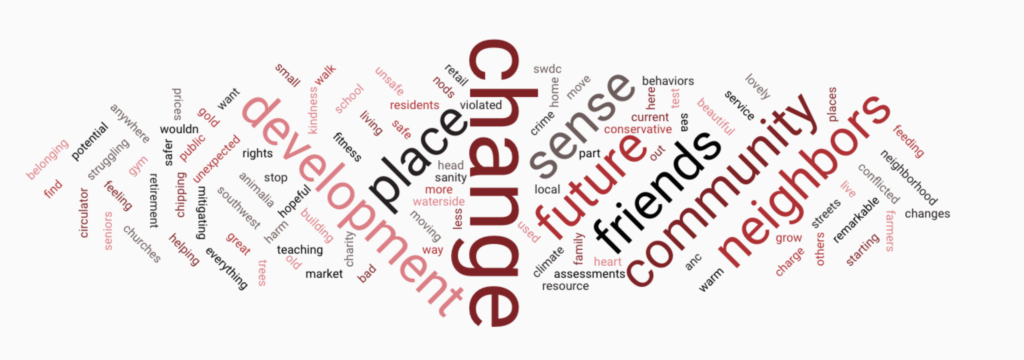
My time partnering with the SWBID has been fascinating, thought-provoking, and rewarding. Firstly, it has been nice to hold deep and interesting conversations with and establish relationships with members of the Southwest DC community. So far, I have learned a lot about the diverse perspectives of individuals’ living situations in SW as well as different interpretations of past and ongoing developmental projects in the area. Due to preconceived ideas, I went into the neighborhood believing that the Southwest residents who have been living there for generations and who are predominantly Black/African-American (not the recently-arrived/predominantly white residents) would speak poorly of the recent projects, since gentrification often disproportionately impacts communities of color. Although the developments do spark a lot of anxiety and have unfortunately impacted the majority of the old residents’ living situations negatively, there were surprisingly more mixed feelings than I anticipated. One resident, for example, expressed her frustration with rising housing prices and gentrification, as expected. However, another resident stated he has been benefiting from the developments due to increased safety and better quality of life.
Another interesting encounter I had was with a lady at the Farmers Market. She informed me how she understands that local organizations are trying to help the needy in SW, but that it often comes at a cost to middle-class residents. She told me that she wishes these organizations conducted more background checks on individuals before placing them in housing in SW, and how these humanitarian efforts have resulted in a more chaotic environment. She also expressed how housing prices have been increasing to a ridiculous amount and how these units have been taking advantage of the working-class. From the points she made, based solely on my interpretation, it seemed like she was expressing two different statements that in her mind were not mutually-exclusive and could exist at the same time: 1. The fact that residents are being taken advantage of financially; and 2. That there needs to be more background checks when assisting the needy with housing in order to not compromise security for the middle-class.
The areas of SW where I have been interacting with folks are the King-Greenleaf Recreation Center; a local food drive located in an apartment complex, and the Farmers Market. What I have noticed and learned is that when I randomly approach residents, most of them look at me a little funny or wonder with suspicion what the purpose of this project is about. However, when there is a trusted community leader or member present to steer the residents towards me, they develop a greater sense of trust and share their stories more freely.
Despite the number of responses we have received, my project partner Ashton and I did run into a few issues in the beginning of the project. When we initially reached out to all the well-known SW organizations and religious centers, most of them did not want to work with us or did not respond to our phone calls and emails. However, the few that did end up answering us have been extremely helpful in connecting us with the community. Additionally, there is often a level of confusion, most specifically among the elderly population, in answering the SenseMaker questions. These confusions are usually with the prompts or with using the triads and dyads in the system. However, these uncertainties have never been an issue with us at all and we have always been ready to help those experiencing trouble with the platform.
Overall, my experience working as a SWBID Community Engagement Fellow has been a positive one, and I hope to continue collecting stories from diverse groups of people and assisting various communities in the future. I am thankful to have received such a wonderful opportunity and I want to express my appreciation to those who have helped me receive the fellowship.
Padideh is a PhD student at the Carter School whose research focuses on identity-based conflict and how collective memories by a nation-state can be utilized to justify human rights violations against a population. Her long-term goal is to develop a multimedia platform centered on people’s stories to showcase the human experience, build empathy across divisions, and spread awareness of societal and political issues that disproportionately impact historically marginalized communities.